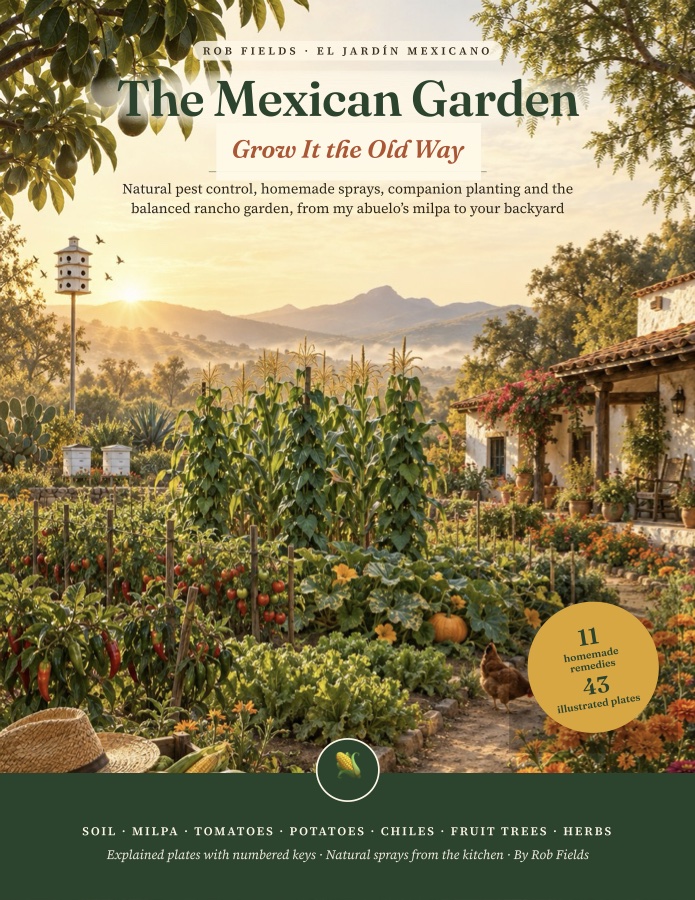
My abuelo never owned a bottle of pesticide. His milpa didn't need one.
Grow it the old way: build the soil, plant crops together so they protect each other, invite the birds and the catarinas to do the hunting, and make your sprays in your own kitchen from garlic, chile, soap and milk.
Buy The Mexican Garden + Backyard Permaculture, get The Living Farm free.
Put both garden books in the same order and The Living Farm (245 pages on soil, water, pasture, animals and the business of farming, a $59.99 value) is added automatically at no charge. It shows as FREE in your cart and downloads with the other two.
Why I wrote it
Every summer when I was a boy, my parents sent me back to my grandparents' rancho in the hills outside Uruapan. My abuelo Ramón grew corn, beans and squash in his milpa, kept bees under the avocado trees, and walked his field every morning before breakfast. He never owned a bottle of pesticide in his life.
This book is about gardening that way. Every planting number in it, the spacing, depth, soil temperature and days to harvest, was checked against university extension services. Where an old saying holds up, I tell you why. Where research says it doesn't, I tell you that too.
Today I garden on two acres outside Fresno with eleven beehives, a flock of chickens, my wife Ana's flower beds, and my daughter Sofía following me down the rows with her own notebook. If I can do it there, you can do it wherever you are.
“Mijo, a milpa takes care of itself, if you let it.” My grandfather, Ramón Campos
The balanced garden
The whole system, on one page.
The Mexican Garden opens with ten rules. If you remember nothing else from the book, remember these. Here are six of them.
Feed the soil, not the plant
Two to three inches of compost or aged abono every year. Strong soil grows strong plants, and strong plants shrug off bugs.“Mijo, a milpa takes care of itself, if you let it.”
Never plant a crop alone
Mix crops, herbs and flowers so pests can't find their target by smell.
Ring the garden with flowers
Marigolds (cempasúchil, which came from Mexico), zinnias, cosmos, dill and alyssum feed the insects that eat your pests.
Walk the rows every morning
El recorrido: fifteen minutes, a bucket of soapy water, and your eyes on the undersides of the leaves.
Barriers before sprays
Collars, row covers, boards and traps solve most problems without a single drop. Spray last, spray mild, spray at dusk.
Nothing is garbage
Husks become collars, weeds become compost, ash goes back to the soil, seed goes in the jar for next year.“In the milpa, nothing is garbage.”
What's inside · The Mexican Garden
63 chapters and guides, from the soil up.
Chapters 1–4 are the system: soil, planning, the ecosystem and natural pest control. Then 23 crop guides, each with a fact panel, varieties, step-by-step growing, companions, a pest table with the natural fix, and El Secreto del Rancho, the one old-way trick for that crop.
Chapter 01
La tierra: soil, compost & manure
Living soil: why pest control starts underground
Manure, the old fertilizer
The compost pile, teas and worm castings
Wood ash, lime and cover crops
Chapter 02
The plan & the old calendar
Laying out the family kitchen garden
Crop rotation by plant family
Planting by the signs and las cabañuelas
Mulch and watering the old way
Chapter 03
The balanced farm
The milpa: Mexico's oldest polyculture
The companion planting chart
Birds, bats, toads and chickens on patrol
Trap crops and sacrifice rows
Chapter 04
11 homemade remedies
Garlic & chile spray, insecticidal soap, neem
Milk spray and baking soda for mildew
Herb tea and horsetail sprays
Slug remedies, Bt and beneficial nematodes
Chapter 05–08
23 planting guides
Tomatoes, chiles, tomatillos and potatoes
Corn, beans, squash, cucumbers and melons
Sweet potatoes, greens and quelites
Herbs, marigolds and the bee garden
Chapter 09–10
Fruit trees & the garden year
Planting, pruning and fruit tree guilds
Citrus, avocado, figs and berries
Saving seed and the month-by-month calendar
Harvest, curing and the root cellar
Look inside
Real pages from the real books
Illustrated plates with numbered keys, homemade remedies with exact amounts, planting tables and printable plans. Click any page to read it full size.
Garden · p. 98 Illustrated Plate XVII: the garlic and chile spray, from the kitchen counter to the leaf.Garden · p. 33 Laying out the family kitchen garden, with how much to plant per person.Garden · p. 4 The contents: soil, the old calendar, companion planting, 11 remedies and 23 crop guides.Backyard Permaculture · p. 22 Illustrated Plate II: building a sheet-mulched bed, layer by layer.Backyard Permaculture · p. 52 Your 12-month plan, one small step at a time, plus first-year budget priorities.Backyard Permaculture · p. 51 Three property patterns: the suburban yard, the half-acre homestead and the smallholding.The Living Farm · p. 49 Plan the next grazing move: look behind the herd as well as ahead of it.The Living Farm · p. 158 Price the whole job: the costs that never send you an invoice.The Living Farm · p. 209 The field toolkit: printable records for grazing, feed, water, costs and cash.
← swipe or use the arrows to see more pages →
Look inside · p. 96
Real recipes for the leaves, too.
Every remedy has exact amounts, a safety box, what research actually says, and an illustrated plate that puts the whole recipe on one page.
Here's Plate XVII, the garlic and chile spray. It costs about a dollar and you already have everything for it.
04 · Remedios caserosThe Mexican Garden
Caldo de ajo y chile
Garlic & chile spray, from the kitchen counter to the leaf
Method
Chop 4–5 garlic cloves and 2 hot chiles. Wear gloves.
Steep in 1 qt warm water, lid on, 12 hours.
Strain through cloth or a coffee filter so the sprayer doesn't clog.
Soap: stir in 1 tsp pure liquid castile soap, gently.
Bottle and label it. Keeps 1 week in the fridge.
Spray leaf undersides, morning or evening, every 5–7 days and after rain.
What research saysGarlic and capsaicin have real repellent activity, but this is a repellent, not a killer. Start when you first see a few aphids, and test one leaf 24–48 hours before you treat the whole plant.
The second garden book
Backyard Permaculture
🎁 Buy with The Mexican Garden → get The Living Farm FREE
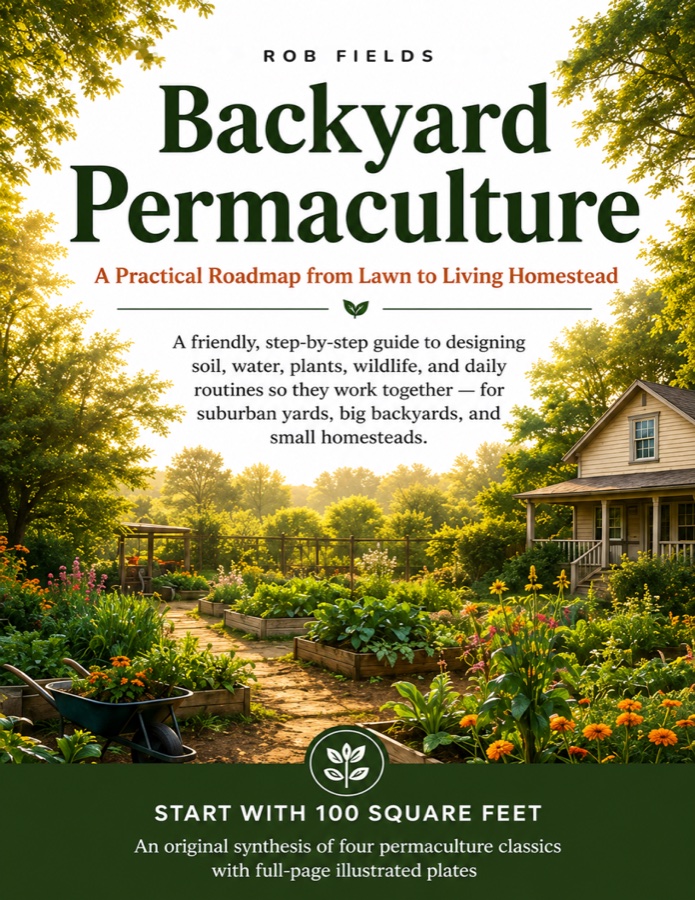
A practical roadmap from lawn to living homestead. Where The Mexican Garden teaches you to grow each crop, this one teaches you to design the whole yard so soil, water, plants, wildlife and your daily routine work together.
Start with 100 square feet. A well-observed, well-placed small system teaches you more than an expensive acre installed too fast. 72 pages, 20 chapters, six illustrated plates, and a toolkit of worksheets you can print.
$19.99$29.99Save $10 today
Part I · Think like a designer
The whole-property test
Observe before you dig
A base map you'll actually use
Zones, sectors and daily flow
Part II · The living foundation
Soil: cover it, feed it, disturb it less
Water: slow it, spread it, sink it, store it
Guilds, polycultures and your first food forest
Three signature beds to build
Part III · Make it work for real life
Maintenance by succession
Three property patterns
Your 12-month plan
Troubleshooting without panic
Your toolkit
Your first weekend: a sheet-mulched bed
Worksheets and field checklists
The workhorse plants
Companion planting: what holds up
The third garden book · Free with the other two
The Living Farm
🎁 FREE when you buy The Mexican Garden + Backyard Permaculture
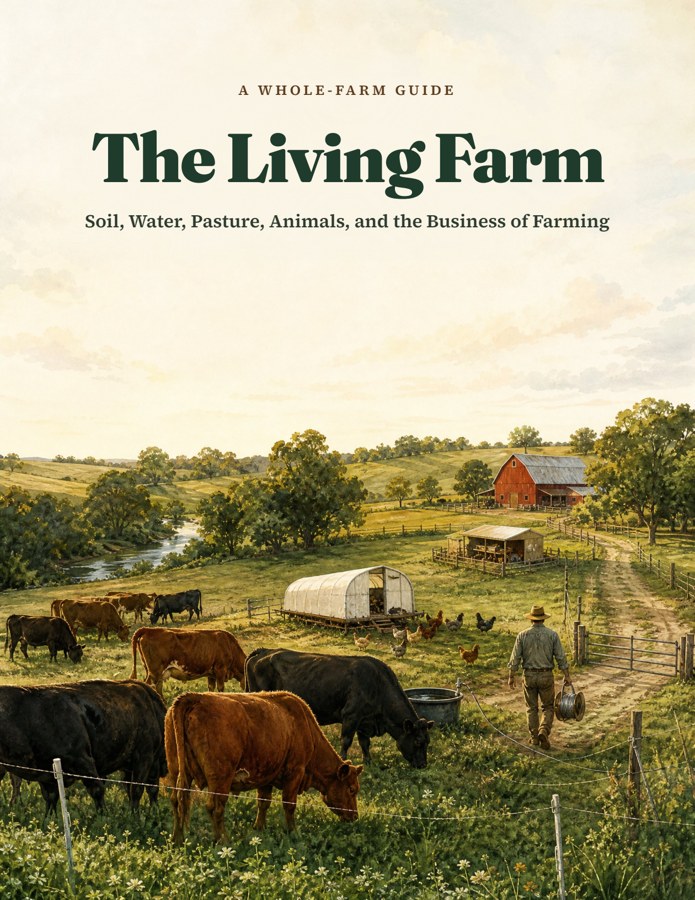
The whole-farm guide: soil, water, pasture, animals and the business of farming, for small livestock and mixed-farm operators. Read the ground before you change it, plan the next grazing move, carry feed through the slow season, match cattle, sheep, goats, poultry and pigs to the land, and price the whole job before you sell a thing.
245 pages, 18 chapters, a glossary, and a field toolkit of printable records: planning map, grazing and recovery, feed inventory, water backup, cost and price, cash timing and more.
Free with both garden books. Add The Mexican Garden and Backyard Permaculture to the same order and The Living Farm comes with them at no charge.
$39.99$59.99Save $20 today
Part I · Understand the place
A farm that works together
Read the ground before you change it
Build soil and keep nutrients useful
Part II · Grow and use the forage
Grow pasture the animals can use
Plan the next grazing move
Carry feed through the slow season
Part III · Animals in the right system
Cattle, sheep and goats matched to the land
Poultry kept moving and well cared for
Pigs, mixed enterprises, health and breeding
Part IV · Make the work practical
Dependable water for the animals
Fences, shelters and equipment that earn their place
A working day that keeps the farm moving
Part V · A durable business
Protect the food from field to customer
Price the whole job and make buying easy
A ninety-day plan through the farming year
Photo: Rob in the garden
Who wrote it
I'm Robert Campos. Rob. Campos means “fields.”
My parents both come from a little town in the hills outside Uruapan, in Michoacán. My dad came north to California in 1976 and spent his whole working life in landscaping and nurseries. I was born and raised in the Central Valley, and every summer as a boy I went back to my grandparents' rancho.
Spanish words appear throughout my garden books, always with the English beside them, because that's how I learned to garden: half in English, half in my abuela's kitchen Spanish.
Rob Fields
+=FREE
Free book offer
Buy The Mexican Garden + Backyard Permaculture, get The Living Farm free.
Put both garden books in the same order and The Living Farm (245 pages on soil, water, pasture, animals and the business of farming, a $59.99 value) is added automatically at no charge. It shows as FREE in your cart and downloads with the other two.
Both garden books + a free third
Grow every crop, and design the whole yard.
Your first book is full price. Every book you add to the same order is $17.50.
Backyard Permaculture: 72 pages, the design roadmap and worksheets
The Living Farm: 245 pages on soil, water, pasture, animals and farm business. Free.
Instant PDF download, phone, tablet or print
Free updates when new editions come out
$57.49$99.97
Three books. Save $42.48, and The Living Farm is free
Secure checkout by Stripe · One payment, no subscription · Instant download
7-day guarantee, no questionsIf it doesn't change how you look at your yard, email me and I'll refund every penny. Keep the books either way.
Every book, one price: $92.49All 5 books, cooking and gardening. $179.95 separately, you save $87.46.
1 · You pay
Through Stripe's secure checkout. I never see your card number.
2 · The book opens
Your download is on the very next screen. Phone, tablet or computer.
3 · Keep the link
Bookmark the download page and come back to it anytime. Stripe emails your receipt.
Questions
Before you buy.
What's the difference between the two books?
The Mexican Garden is the big one: 336 pages on growing food the old rancho way, with 23 crop guides, 11 homemade remedies and 43 illustrated plates. Backyard Permaculture is a 72-page design guide: how to lay out your whole yard so soil, water, plants and animals work together, starting with 100 square feet.
I only have a small yard, or a few pots. Is this for me?
Yes. Backyard Permaculture is built around starting with 100 square feet, and most of the crop guides and remedies in The Mexican Garden work the same in raised beds and containers.
I don't live anywhere near California.
Planting times are given relative to your last spring frost date, so the books work wherever you are. Look up your frost date and USDA zone and write them on the inside cover.
Are the homemade sprays safe?
Every remedy has a safety box: patch-test one leaf first, spray at dusk, keep it off open flowers when bees are flying. The book also tells you plainly where research says an old remedy works, and where it doesn't.
How do I get The Living Farm free?
Put The Mexican Garden and Backyard Permaculture in the same order and The Living Farm is added free. It shows as FREE in your cart and downloads with your other books. You can also buy it on its own.
How does the bundle price work?
Your first book is full price. Every book you add to the same order is $17.50. The cart shows the savings before you pay.
What if it isn't for me?
Email support@robfieldsbooks.com within 7 days and I'll refund you in full. Keep the book.
One more thing
The best time to start is before you plant anything.
Get the book, walk your yard this weekend with a notebook, and next season you'll know your ground the way my abuelo knew his.